Showing posts with label Understanding. Show all posts

Monday, May 29, 2017

Darling, do I understand you enough?

Image may contain: one or more people, twilight and sky

From time to time, sit close to the one you love, hold his or her hand, and ask, “Darling, do I understand you enough? Or am I making you suffer? Please tell me so that I can learn to love you properly. I don’t want to make you suffer, and if I do so because of my ignorance, please tell me so that I can love you better, so that you can be happy.” If you say this in a voice that communicates your real openness to understand, the other person may cry. That is a good sign, because it means the door of understanding is opening and everything will be possible again.
Thich Nhat Hanh, in "Peace Is Every Step"

10 things science (and Buddhism) says will make you happy


I’m a science geek as well as a Buddhist geek, and recently when I was leading a retreat on how to bring more joy into our lives I found myself making a lot of references to an article published in Yes magazine, which touched on ten things that have been shown by science to make us happier. It seemed natural to draw upon the article because so much of the research that was described resonated with Buddhist teachings.
So I thought it would be interesting to take the main points of the article and flesh them out with a little Buddhism.
1. Be generous
“Make altruism and giving part of your life, and be purposeful about it,” Yes magazine says. “Researcher Elizabeth Dunn found that those who spend money on others reported much greater happiness than those who spend it on themselves.”

Sunday, May 28, 2017

Dare to practise


HAPPINESS FOR THE LAY PERSON

By Venerable Balacitta

Image may contain: indoor


The Buddha once described (in AN 4:62) 4 different kinds of happiness that can be attained by a lay person. These are based on:

1. Wealth obtained by righteous means
2. Enjoyment of such wealth
3. Freedom from debt
4. Blamelessness 

Saturday, May 27, 2017

AN 3.109

Image may contain: 1 person, sitting

The Buddha said to Anathapindika the householder: 
"Householder, when the mind is unprotected, bodily actions are unprotected as well, verbal actions are unprotected as well, mental actions are unprotected as well. When one’s bodily actions, verbal actions, & mental actions are unprotected, one’s bodily actions get soggy, one’s verbal actions get soggy, one’s mental actions get soggy. When one’s bodily actions, verbal actions, & mental actions are soggy, one’s bodily actions… verbal actions… mental actions rot. When one’s bodily actions, verbal actions, & mental actions rot, one’s death is not auspicious, the mode of one’s dying not good."

If you use samādhi to resist your desire without knowing the purpose of doing so, you will not be able to get rid of your desire entirely

Image may contain: 1 person, outdoor

Question:  I can see my desire but I feel so weak and am unable to resist and resolve it. How can I lessen my desire and eventually uproot it?

Than Ajahn:  First of all you need to develop mindfulness. If you have mindfulness you can disregard your desire when it arises. When you have desire, you just concentrate on your meditation subject, like reciting a mantra: Buddho, Buddho. If you can keep repeating Buddho, Buddho, eventually your desire will disappear temporarily. This is the first step of engaging with your desire.

Friday, May 26, 2017

When and where was the Tipitaka first written?

May 1, 2017


article_image
In an article I wrote for The Island and which was published on 21st April 2017, I highlighted several well-known details about the life of the Buddha, which most Buddhists assume come from the Tipitaka, but which in fact cannot be found there. I went on to suggest that some of these stories may well have been created centuries after the Buddha. Several people have responded to this article, including Dr. Chandre Dharmawardene of Canada. In his response he mentions that the Tipitaka was first committed to writing in the 1st century BCE at Aluvihara in Sri Lanka. In saying this Dr. Dharamawardene is of course in accordance with generally accepted and oft repeated ‘fact.’ However, it is a ‘fact’ that I would like to reassess.

Don't ignore your suffering

Image may contain: plant, cloud, sky, flower, outdoor and nature

If you have experienced hunger, you know that having food is a miracle. If you have suffered from the cold, you know the preciousness of warmth. When you have suffered, you know how to appreciate the elements of paradise that are present. If you dwell only in your suffering, you will miss paradise. Don't ignore your suffering, but don't forget to enjoy the wonders of life, for your sake and for the benefit of many beings.

- Thich Nhat Hanh, in “The Heart of the Buddha's Teaching”.  Photo: Noel CasajeKevin Ooi

You have to know that you are breathing in now, or you are breathing out now


Question: In breath meditation, there are different points of focusing ie focusing on different parts of the body like at the tip of the nose, or in the diaphragm or in the throat. How do I chose which point of focusing is suitable for me?

Thursday, May 25, 2017

The Buddha’s Victory Over A God & Demon

As summarised from the Brahma-Nimantanika Sutta, the Buddha spoke of an occasion, when a wrong view arose in the mind of Baka Brahma, a god residing in Maha Brahma Heaven. He had assumed that his existence and world was constant, permanent, eternal and total (‘salvation’), not subject to ageing, death and rebirth. The Buddha thus swiftly manifested in his world to instruct him. Welcomed by Baka Brahma, who repeated his thoughts to him, the Buddha exclaimed that he was actually being ignorant by mistaking so. Just then, Mara, the most evil god (a heavenly ‘demon’ from the Paranimmita-Vasavatti Heaven) possessed an attendant of Baka Brahma and told the Buddha not to rebuke him, for he is ‘the Maha (Great) Brahma, the Conqueror, Unconquered, Omniscient, Omnipotent, Creator, Most High Providence, Father of All That Have Been and Shall Be.’

Wednesday, May 24, 2017

Image may contain: plant, tree, nature and outdoor

While walking in the woods with a group of children last year, I noticed one of the little girls thinking for a long time. Finally, she asked me, "Grandfather monk, what color is that tree's bark?" "It is the color that you see," I told her. I wanted her to enter the wonderful world that was right in front of her. I did not want to add another concept.
Thich Nhat Hanh Photo: Béatrice Lechtanski

What would you do if someone said, "I am the perfectly enlightened one"?


As Ajahn Sumedho noted:
"Within the Buddhist world, there are not many Buddhists who use the Four Noble Truths anymore, even in Thailand. People say, ‘Oh yes, the Four Noble Truths - beginner’s stuff.’ Then they might use all kinds of vipassana techniques and become really obsessed with the sixteen stages before they get to the Noble Truths. I find it quite boggling that in the Buddhist world the really profound teaching has been dismissed as primitive Buddhism: ‘That’s for the little kids, the beginners. The advanced course is....’ They go into complicated theories and ideas - forgetting the most profound teaching.
The Four Noble Truths are a lifetime’s reflection. It is not just a matter of realising the Four Noble Truths, the three aspects, and twelve stages and becoming an arahant on one retreat - and then going onto something advanced. The Four Noble Truths are not easy like that. They require an ongoing attitude of vigilance and they provide the context for a lifetime of examination"

Tuesday, May 23, 2017

Dare to do it


This body is just a composition of the four elements. There is no person in that body – no father, no mother, no brother, no sister


Image may contain: one or more people and people sitting

Question: I am practicing the meditation on the 32 parts. May you give me some advice about how to practice it, in order to get the most benefits possible?

Than Ajahn:  You can use it for samatha or vipassanā. Samatha is to make your mind peaceful and calm. Instead of repeating Buddho, you can repeat the 32 parts: hair of the head, hair of the body, nails, teeth, skin, flesh, bones, heart, lungs, liver, kidneys, etc. You memorise it and repeat it. If you keep reciting this 32 parts, your mind can become peaceful and calm and you will have samādhi. This is one method.

Monday, May 22, 2017

I will advise that if you are born as a human being now, you should practise now. There is a Buddha’s teaching now. So now is the best time to practise


Question:  Ajahn Suwat said that in the future it is not worthwhile to wish to be reborn as human being as conditions are going to be very hard to a point where it will be difficult to practice the Dhamma and it will be better to be reborn in the deva realms to practise from there. Will you advice the same?

Than Ajahn:  I will advise that if you are born as a human being now, you should practise now. Don’t worry about your future lives because you cannot guarantee where you are going to be reborn. You are a human being now and there is a Buddha’s teaching now. So now is the best time to practise.

Saturday, May 20, 2017

Beginning Anew

Image may contain: outdoor

The Buddhist teaching on Beginning Anew is very clear: 
"The un-skillfulness comes from our mind, and the un-skillfulness can be transformed by our mind…” 
If there is light, there is enlightenment in your consciousness; there is a strong determination, the awareness that "This is something negative, this is something harmful… and I am determined not to allow it to happen again," and then the mind is transformed… And now, with your enlightenment, with your determination, you will never allow these conditions to come together again in order to repeat the same thing.
Thich Nhat Hanh, in ”Beginning Anew” Dharma Talk. Photo: Brigitta Moser

Friday, May 19, 2017

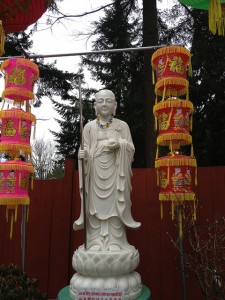
The Bodhisattva

geraldford, flickr ccgeraldford, flickr cc
The Bodhisattva is willing to be authentic, willing to get hurt and be sensitive and have a fully exposed heart. A Bodhisattva cooperates with the world instead of making enemies with everything all the time. Bodhisattvas are sometimes called spiritual warriors, described as daring and fearless. On the Bodhisattva path you have to let go of the lies that you tell yourself all the time. You have to put all of your egocentric bullshit aside and face things as they really are.
That’s why it’s fearless.
When we put that aside we are free to be more genuine and authentic. This path isn’t so much about manifesting Enlightenment as it is about expanding our openness, gentleness, and compassion. But, I suppose when you get down to it that, in itself, is Enlightenment.

Good actions will lead you to be able to meditate


Image may contain: one or more people, people standing and outdoor

Question:  If I do good actions, I gain kusala karma and if I do bad actions, I acquire akusala karma. Both ways, I am going to be reborn again and again. If I don’t do anything, I won’t accumulate any karma. Why should I do good actions because if I accumulate a lot of kusala karma, I may be reborn in the Rūpa or Arūpa realms whose lifespan is in maha-kappa. I will be wasting my time there since my goal as a Buddhist is to attain Nibbāna. So why should I do good kamma?