Monday, May 29, 2017

Darling, do I understand you enough?

Image may contain: one or more people, twilight and sky

From time to time, sit close to the one you love, hold his or her hand, and ask, “Darling, do I understand you enough? Or am I making you suffer? Please tell me so that I can learn to love you properly. I don’t want to make you suffer, and if I do so because of my ignorance, please tell me so that I can love you better, so that you can be happy.” If you say this in a voice that communicates your real openness to understand, the other person may cry. That is a good sign, because it means the door of understanding is opening and everything will be possible again.
Thich Nhat Hanh, in "Peace Is Every Step"

Enlightenment - The Story

https://www.facebook.com/TrueBuddhistTeachings/videos/1840607702857341/

One day, seated beneath the Bodhi tree (the tree of awakening) Siddhartha became deeply absorbed in meditation, and reflected on his experience of life, determined to penetrate its truth. He finally achieved Enlightenment and became the Buddha.

10 things science (and Buddhism) says will make you happy


I’m a science geek as well as a Buddhist geek, and recently when I was leading a retreat on how to bring more joy into our lives I found myself making a lot of references to an article published in Yes magazine, which touched on ten things that have been shown by science to make us happier. It seemed natural to draw upon the article because so much of the research that was described resonated with Buddhist teachings.
So I thought it would be interesting to take the main points of the article and flesh them out with a little Buddhism.
1. Be generous
“Make altruism and giving part of your life, and be purposeful about it,” Yes magazine says. “Researcher Elizabeth Dunn found that those who spend money on others reported much greater happiness than those who spend it on themselves.”

Sunday, May 28, 2017

Ven. Henepola Gunaratana - Mindfulness in plain English


Image may contain: 1 person, sitting


From the Buddhist point of view, we human beings live in a very peculiar fashion. We view impermanent things as permanent, though everything is changing all around us. The process of change is constant and eternal.

Dare to practise


HAPPINESS FOR THE LAY PERSON

By Venerable Balacitta

Image may contain: indoor


The Buddha once described (in AN 4:62) 4 different kinds of happiness that can be attained by a lay person. These are based on:

1. Wealth obtained by righteous means
2. Enjoyment of such wealth
3. Freedom from debt
4. Blamelessness 

Saturday, May 27, 2017

Piers Morgan meets his Holiness the Dalai Lama on 26 APRIL 2017

on 26 APRIL 2017 


Piers Morgan meets the Dalai LamaIn September 2016 Piers Morgan met his Holiness the Dalai Lama — and the pair talked about everything, from Mr Trump, to IS, to love and marriage and even celebrity culture.
Watch the full (40-minute, uncut), fascinating discussion.

It was the interview that got the internet buzzing and now we [itv.com/goodmorningbritain] bring you the full 40-minute, uncut version.

AN 3.109

Image may contain: 1 person, sitting

The Buddha said to Anathapindika the householder: 
"Householder, when the mind is unprotected, bodily actions are unprotected as well, verbal actions are unprotected as well, mental actions are unprotected as well. When one’s bodily actions, verbal actions, & mental actions are unprotected, one’s bodily actions get soggy, one’s verbal actions get soggy, one’s mental actions get soggy. When one’s bodily actions, verbal actions, & mental actions are soggy, one’s bodily actions… verbal actions… mental actions rot. When one’s bodily actions, verbal actions, & mental actions rot, one’s death is not auspicious, the mode of one’s dying not good."

If you use samādhi to resist your desire without knowing the purpose of doing so, you will not be able to get rid of your desire entirely

Image may contain: 1 person, outdoor

Question:  I can see my desire but I feel so weak and am unable to resist and resolve it. How can I lessen my desire and eventually uproot it?

Than Ajahn:  First of all you need to develop mindfulness. If you have mindfulness you can disregard your desire when it arises. When you have desire, you just concentrate on your meditation subject, like reciting a mantra: Buddho, Buddho. If you can keep repeating Buddho, Buddho, eventually your desire will disappear temporarily. This is the first step of engaging with your desire.

Friday, May 26, 2017

When and where was the Tipitaka first written?

May 1, 2017


article_image
In an article I wrote for The Island and which was published on 21st April 2017, I highlighted several well-known details about the life of the Buddha, which most Buddhists assume come from the Tipitaka, but which in fact cannot be found there. I went on to suggest that some of these stories may well have been created centuries after the Buddha. Several people have responded to this article, including Dr. Chandre Dharmawardene of Canada. In his response he mentions that the Tipitaka was first committed to writing in the 1st century BCE at Aluvihara in Sri Lanka. In saying this Dr. Dharamawardene is of course in accordance with generally accepted and oft repeated ‘fact.’ However, it is a ‘fact’ that I would like to reassess.

Don't ignore your suffering

Image may contain: plant, cloud, sky, flower, outdoor and nature

If you have experienced hunger, you know that having food is a miracle. If you have suffered from the cold, you know the preciousness of warmth. When you have suffered, you know how to appreciate the elements of paradise that are present. If you dwell only in your suffering, you will miss paradise. Don't ignore your suffering, but don't forget to enjoy the wonders of life, for your sake and for the benefit of many beings.

- Thich Nhat Hanh, in “The Heart of the Buddha's Teaching”.  Photo: Noel CasajeKevin Ooi

You have to know that you are breathing in now, or you are breathing out now


Question: In breath meditation, there are different points of focusing ie focusing on different parts of the body like at the tip of the nose, or in the diaphragm or in the throat. How do I chose which point of focusing is suitable for me?

Thursday, May 25, 2017

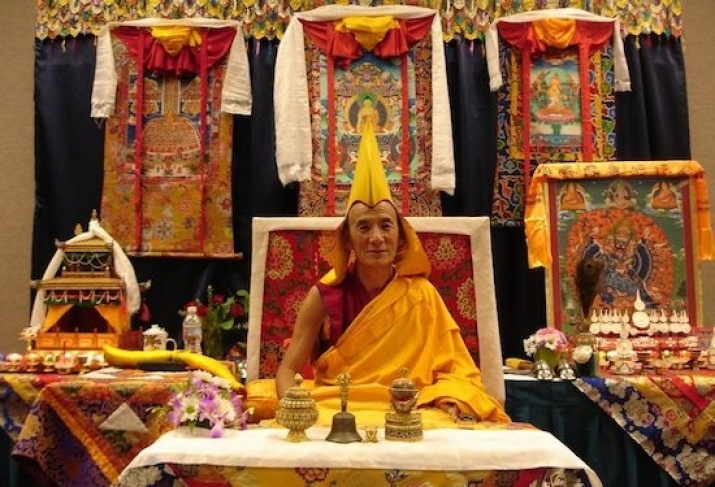
His Holiness the 103rd Gaden Tripa, Head of the Gelug School, Passes Away

By Craig Lewis Buddhistdoor Global 2017-04-24 

His Holiness the 103rd Gaden Tripa. From tibet.netHis Holiness the 103rd Gaden Tripa. From tibet.net
The 103rd Gaden Tripa, His Holiness Jetsun Lobsang Tenzin, the spiritual head of the Gelug school of Tibetan Buddhism, has passed away at the age of 80, the Central Tibetan Administration announced. Rinpoche had recently been admitted to the intensive care unit of Max Hospital in New Delhi after several months of illness. 

Children Becoming Buddhist Monks

https://www.facebook.com/todayonline/videos/10154717044117572/

WATCH: Children get their heads shaved by Buddhist monks during a ceremony called 'Children Becoming Buddhist Monks' at the Jogye Temple in South Korea. Following the ceremony, the children will stay at the temple where they are taught about Buddhism until Buddha's birthday on May 3.


The Buddha’s Victory Over A God & Demon

As summarised from the Brahma-Nimantanika Sutta, the Buddha spoke of an occasion, when a wrong view arose in the mind of Baka Brahma, a god residing in Maha Brahma Heaven. He had assumed that his existence and world was constant, permanent, eternal and total (‘salvation’), not subject to ageing, death and rebirth. The Buddha thus swiftly manifested in his world to instruct him. Welcomed by Baka Brahma, who repeated his thoughts to him, the Buddha exclaimed that he was actually being ignorant by mistaking so. Just then, Mara, the most evil god (a heavenly ‘demon’ from the Paranimmita-Vasavatti Heaven) possessed an attendant of Baka Brahma and told the Buddha not to rebuke him, for he is ‘the Maha (Great) Brahma, the Conqueror, Unconquered, Omniscient, Omnipotent, Creator, Most High Providence, Father of All That Have Been and Shall Be.’

Wednesday, May 24, 2017

Image may contain: plant, tree, nature and outdoor

While walking in the woods with a group of children last year, I noticed one of the little girls thinking for a long time. Finally, she asked me, "Grandfather monk, what color is that tree's bark?" "It is the color that you see," I told her. I wanted her to enter the wonderful world that was right in front of her. I did not want to add another concept.
Thich Nhat Hanh Photo: Béatrice Lechtanski

In South Korea, pretty much everything is a little bit Buddhist. Including politics

By Matthew Bell, WVXU, Apr 26, 2017


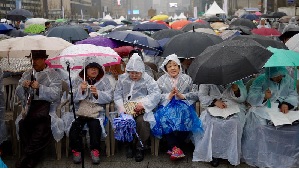
South Korean Buddhists gather every year to recite the Diamond Sutra with monks from the Jogye Temple in Seoul. This year was special, with a presidential election coming up on May 9th.

Seoul, South Korea
 -- The weather was simply awful. But the cold, wind and rain didn’t deter thousands of people from attending an annual ritual in downtown Seoul on a recent weekday afternoon.

People came to chant the words of the Diamond Sutra from Buddhist scripture with senior monks from the Jogye Order, the most prominent sect in Korean Buddhism, who presided over the event.

Also on hand were officials from most of South Korea’s major political parties.

What would you do if someone said, "I am the perfectly enlightened one"?


As Ajahn Sumedho noted:
"Within the Buddhist world, there are not many Buddhists who use the Four Noble Truths anymore, even in Thailand. People say, ‘Oh yes, the Four Noble Truths - beginner’s stuff.’ Then they might use all kinds of vipassana techniques and become really obsessed with the sixteen stages before they get to the Noble Truths. I find it quite boggling that in the Buddhist world the really profound teaching has been dismissed as primitive Buddhism: ‘That’s for the little kids, the beginners. The advanced course is....’ They go into complicated theories and ideas - forgetting the most profound teaching.
The Four Noble Truths are a lifetime’s reflection. It is not just a matter of realising the Four Noble Truths, the three aspects, and twelve stages and becoming an arahant on one retreat - and then going onto something advanced. The Four Noble Truths are not easy like that. They require an ongoing attitude of vigilance and they provide the context for a lifetime of examination"

Tuesday, May 23, 2017

New Buddhist temple in St. Louis Park hopes to become center of Thai culture


By Miguel Otárola, Star Tribune, April 11, 2017


A Thai Buddhist center is moving into an old church in St. Louis Park. 

St. Louis, MN (USA) 
-- The monks, draped in orange robes, sat side-by-side in 

the gathering hall of the Thai Buddhist Center of Minnesota, an arrangement of 
flowers displayed in front of each one.

Buddhist monks prayed
and blessed attendees
during the Thai New Year
Celebration.


Visitors, each holding a bowl of
water, slowly moved toward the
monks. They poured water on
their palms, and it dribbled onto
the flowers below.

For the Thai, the water
ceremony is a symbolic 

acceptance of the monks’
blessings. It was one of many traditions celebrated Sunday at the center’s Thai
New Year festival, the first event held in the community’s new temple, a former
Lutheran church in the Birchwood neighborhood of St. Louis Park.

Dare to do it