Showing posts with label Opinion. Show all posts

Wednesday, May 24, 2017

In South Korea, pretty much everything is a little bit Buddhist. Including politics

By Matthew Bell, WVXU, Apr 26, 2017


South Korean Buddhists gather every year to recite the Diamond Sutra with monks from the Jogye Temple in Seoul. This year was special, with a presidential election coming up on May 9th.

Seoul, South Korea
 -- The weather was simply awful. But the cold, wind and rain didn’t deter thousands of people from attending an annual ritual in downtown Seoul on a recent weekday afternoon.

People came to chant the words of the Diamond Sutra from Buddhist scripture with senior monks from the Jogye Order, the most prominent sect in Korean Buddhism, who presided over the event.

Also on hand were officials from most of South Korea’s major political parties.

Monday, May 22, 2017

Thousands of Japanese Buddhist temples left 'priestless'

by ALEXANDER MARTIN, Nikkei Asian Review, April 26, 2017


Nearly 13,000 lack resident leaders as depopulation gnaws at community pillars

TOKYO, Japan 
-- Japan is home to more Buddhist temples than convenience stores, but many are struggling to find the parishioners they need to stay afloat. As congregations shrink, thousands of temples are going without resident priests.

<< Japan's Buddhist temples rely on ceremonial fees and collections from local supporters. 


A survey released by the Kyoto Shimbun newspaper this week shows that nearly 13,000 of the approximately 75,000 Buddhist temples in the country do not have resident priests or are co-managed by chief priests from other temples.

Sunday, May 21, 2017

On the Nothingness of God: A Zen Meditation

finger
Back in 2008 I read a review of the book Merton & Buddhism: Wisdom, Emptiness & Everyday Mind edited by Bonnie Bowman Thurston. The reviewer cited a particular line that I’ve not been able to shake. “(W)hen the Dalai Lama was asked if he believed in God, he replied ‘It depends on what you mean by ‘God’: if you mean by ‘God’ What Thomas Merton means, then yes, I do.’”
This very much caught my imagination. And, I wrote on the subject, on the yes, and the implied no, and within that the power of nothingness. I find myself think of this again. And, thought I’d take another run at that mystery.

Saturday, May 20, 2017

The Zen of Weight Loss: Further Reflections on my Consciousness Diet

Weigh In
Today I officially became a life time member of Weight Watchers.
What that means is that I achieved my official “goal” weight, and now six weeks from that weigh in I’ve been able to stay within four pound range of my achieved goal weight (two tenths of a pound over the mid-point, thank you for asking). And now as long as I keep within some parameters, mainly not exceeding that goal weight by more than two pounds and weighing in at least once a month, there are no continuing fees for my participation at Weight Watchers.

Friday, May 19, 2017

Kyoto-based Buddhist group struggles with decline in temples and priests

The Japan Times, Apr 24, 2017


KYOTO, Japan -- A Kyoto-based Buddhist group with the largest number of followers in Japan is boosting its support to its member temples in other prefectures amid a shortage of incoming chief priests and a decline in danka (financial supporters).

The main building of a Buddhist temple in the city of Toyama has been pulled down after its organization was dissolved. The Honganji group started offering support to member temples suffering from a shortage of priests and local supporters.

In Toyama Prefecture, a temple of the Honganji sect of Jodo Shinshu, also known in English as “Shin Buddhism,” has been unattended for a long time, with weeds and bamboo growing around the grounds and tiles falling off from the eaves of the main hall.

Wednesday, May 17, 2017

Science and Buddhism Agree: There Is No "You" There

by Lori Chandler
Article Image
Evan Thompson of the University of British Columbia has verified the Buddhist belief of anatta, or not-self. Neuroscience has been interested in Buddhism since the late 1980s, when the Mind and Life Institute was created by HH Dalai Lama and a team of scientists. The science that came out of those first studies gave validation to what monks have known for years — if you train your mind, you can change your brain. As neuroscience has begun studying the mind, they have looked to those who have mastered the mind.

Tuesday, May 16, 2017

This is how Buddhist monks live without money

by Tree Watson, Economy, 15 April 2017


Laypeople and the monastic community have a relationship of mutual dependence. It's called 'gift economics'

"Take money, for example. In the past there wasn’t any paper money. Paper was just paper, without any value. Then people decided that silver money was hard to store, so they turned paper into money. And so it serves as money."

"Maybe someday in the future a new king will arise who doesn’t like paper money. He’ll have us use wax droppings instead—take sealing wax, melt it, stamp it into lumps, and suppose it to be money. We’ll be using wax droppings all over the country, getting into debt all because of wax droppings. Let alone wax droppings, we could take chicken droppings and turn them into money! It could happen. All our chicken droppings would be cash. We’d be fighting and killing one another over chicken droppings."

-- Ajahn Chah, monk, founder of two major monasteries in the Thai Forest Tradition, & instrumental  figure in the establishment of Theravada Buddhism in the West

Sunday, May 14, 2017

Monk walks into a bar... His own

Published  8:55 PM, APRIL 21, 2017  Today Weekend

TOKYO — Drinking at your neighbourhood bar would appear to be inconsistent with a Buddhist’s quest for clarity of mind and enlightenment.

Intoxicants, after all, have the effect of clouding the senses, not to mention one’s judgement.

But for Buddhist monk Yoshinobu Fujioka, who operates a bar in central Tokyo with other clergy of his faith, nirvana — it appears — is just a sip away.

The Vowz Bar, which has found its niche among Japanese professionals, students and foreign tourists, is already in its 17th year of business. Add a rock band to the mix, and this group of Buddhist monks is taking unorthodoxy to new heights.

Tuesday, May 9, 2017

Calming Your Mind Buddhist-Style – A 30-Second Method for Non-Buddhists and Buddhists Alike

Sitting - Flickr Commons - Anthony Arrigo
Sitting – Flickr Commons – Anthony Arrigo

In recent weeks, given the political turmoil in the world, I’ve heard from a lot of people who are wondering how to calm their minds. It’s painful and unhelpful to be caught up in anxiety, anger, reactivity, despair, fear, and worry about the future. In addition, these kinds of emotions are what Buddhists call afflictive – that is, they are self-perpetuating and suck up a lot of our energy. Stewing in anxiety, for example, generally leads to more anxiety and exhaustion, not to solutions or relief.

Sunday, May 7, 2017

Transmutation of Suffering: The Magic of Tonglen

Tonglen meditation is a healing practice. The word tonglen is Tibetan, and means “giving and taking.” It is also translated as “sending and receiving.” Rooted deeply in Tibetan Buddhist teachings of mindfulness and service, tonglen is designed to transmute and transcend suffering, not only on the personal level but on the global as well.
His Holiness the Dalai Lama practices tonglen.
His Holiness the Dalai Lama
Seeking ease for ourselves is not always synonymous with working toward the liberation of all beings. But, in the case of tonglen, the transformation of discomfort is a path that allows for healing, transformation, and liberation on all levels. His Holiness the Dalai Lama has said that he practices tonglen everyday. This is what he says of the practice; “Whether this meditation really helps others or not, it gives me peace of mind. Then I can be more effective, and the benefit is immense.”

Friday, May 5, 2017

Bodhicitta and the Spiritual Warrior

Photo by Dean Hocham, Flickr C.C.
The way of the Bodhisattva is the way of compassion and wisdom, of realizing your own boundless potential. It comes from realizing that Enlightenment is our true nature, that we have a basic goodness and wakefulness that is fundamental to our being.
Bodhicitta is what the diligence of the Bodhisattva is based on. Bodhicitta means mind of awakening. It’s what helps us overcome the delusions that keep us from seeing our true nature. These delusions are things that we can overcome. They are impermanent like everything else. They may obscure our minds, but we can overcome them. Bodhicitta is our tool for doing this.

When is walking Meditation? A Zen Reflection

old couple walking
I have friends who suggest anything they really like doing is a meditation. When they’re not just being cute or ironic the principal they seem to rely on for this assertion is that such things as knitting, bowling, cooking, all involve concentration and at best, perhaps, an achieving of a sense of “oneness” with the object of their concentration. I have little argument with such an observation and indeed many of the so-called Zen arts such as tea ceremony and archery are such joining of action and attention.
But there is another kind of meditation that has no goal, no purpose other than just being.
In my life this is mainly encountered on the meditation pillow. And I know it can take many forms, possibly even in knitting, bowling and cooking.

Thursday, May 4, 2017

Zen: The Mystic Flower

Zen is a culture of awakening. It doesn’t really match any of the categories we tend to want to put things into in western thought. It defies labels like religion and philosophy. It’s not something to believe. It’s not even something to be. It’s a practice. It’s a way of life.
Zen is like the flower of Buddhism. Beneath it lies the roots of developed doctrine and practice, which has been cultivated for over two thousand years. Beneath these roots are the basic principles that are the foundation of all of the myriad branches of Buddhism. In the case of Zen this flower was planted in China and some of it’s practice was clearly influenced by the spiritual traditions that already existed there. Now it has been planted here in the west.

Wednesday, May 3, 2017

The Souls of China: The Return of Religion After Mao by Ian Johnson

book lead - The Souls of China

T he 20th century wrought havoc on religious and spiritual life in mainland China, especially during the Cultural Revolution. Temples were torn down, believers persecuted and priests, monks and nuns subjected to violence and forced to renounce their religious ways. It must have seemed as though all traditional religious practices would vanish from the country.

Return of religion to China since the death of Mao documented in new book The Souls of China. By following individual monks and priests, Pulitzer Prize-winning author Ian Johnson personalises his account of the reawakening of religious belief and practices in China. 
Allen Lane 13 APR 2017 A Buddhist monk rings a bell with a wooden hammer at the Arhat temple in Chongqing. Picture: AFP
A buddhist monk rings a bell with a wooden hammer at the Arhat temple in Chongqing. AFP 
Yet, since the late 1970s, religion has slowly been returning to China, as millions of Chinese search for something other than material wealth. Some have looked to old religions such as Taoism and Buddhism while others have turned to a more modern import, Christianity, for answers.

Tuesday, May 2, 2017

Buddhism isn’t really a religion, is it? By Diana St Ruth

BY  on 8 APRIL 2017 


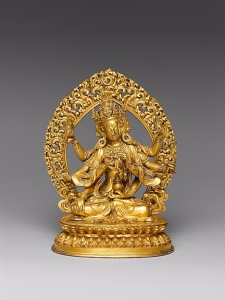
Ushnishavijaya (Zun Sheng fo mu) is a Buddhist Deity. China © Metropolitan Museum of ArtAs westerners most of us have come to Buddhism of our own accord. We were never pressed into it by our culture, society or, usually anyway, by our families. On the contrary, our culture and families can be quite hostile towards a religion like Buddhism. Some people seem to get round this by saying they aren’t ‘Buddhist’ as such because they don’t go in for labels; they’re simply interested in Buddhism as they are in many ­other things, ‘After all, Buddhism isn’t really a religion, is it? It’s more a way of Life.’
The excuses come out and maybe we ease feelings of disloyalty towards ‘our’ group and also ward off any whispers or criticisms from our friends. That look of horror that can sweep across someone’s face when you tell them what you are doing with your life can be quite off-putting; it sort of says, ‘Are you feeling all right? Have you lost it a bit?’

Friday, April 28, 2017

What Happens When We Die? Here's What e-Buddhism Says!

e-Buddhism

The Buddha’s teachings offers the most satisfactory explanation of where man came from and where he is going. When we die, the mind, with all the tendencies, preferences, abilities and characteristics that have been developed and conditioned in this life, re-establishes itself in a new being. Thus the new individual grows  and develops a personality conditioned both by the mental characteristics that have been carried over from the previous life and by the new environment. The personality will change and be modified by conscious effort and conditioning factors like education, parental influence and society but once again at death, it will re-establish itself as life in a new being. This process of dying and being reborn will continue until the conditions that cause it, the mental factors of craving and ignorance, cease. When they do, instead of being reborn, the mind attains a state called Nirvana.

Thursday, April 27, 2017

Regular Everything, by John Aske

BY  on 24 FEBRUARY 2017 

Stupa (chorten), 17th–18th century Tibet. © Metropolitan Museum of Art We all like things to be regular, and what’s wrong with that, you might reasonably ask? We all want stable conditions as well. We don’t want anything to change, either — we want it to stay the same — or more or less, always.
Having a regular job, regular meals and somewhere regular to sleep at night can only be good, better than sleeping in a ditch and being hungry all the time. The gravedigger at Drewsteignton preferred to sleep under a hedge, he told me, because a roof ‘made the place stuffy,’ but he was an unusual man.
But these are all physical conditions, and though they can strongly affect the way we behave and think (our views and opinions), we must be careful that they do not blind us to what is really happening. It is not so much what we have, but what we depend upon having, now and in the future, that gives us problems.

The Dalai Lama criticizes Trump’s “America First” policy

In the video posted by England’s Channel 4 News yesterday (below), the Dalai Lama also discusses the need for a compassionate cultural revolution in China and the possibility of the end of his line of rebirths.
Speaking of the Trump policy, he said:
“I believe, with admiration, America as a leading nation of the free world. So, some new thinking: ‘Only America’, ‘First America’, right?  ‘America First’ – I feel a little bit… disagreement. As a leading nation of the free world, America should act with that spirit…”

Tuesday, April 25, 2017

A 'Buddhist boot camp' in Thailand offers pain -- and gain

April 6, 2017 DENIS D. GRAY Nikkei Asian Review

A 10-day retreat with no talking, no mobile phones and plenty of meditation is not for the fainthearted


A man meditates on a bench in front of a lake in Lumphini Park in Bangkok. © AP
Variously savored for its sun, sand and smiles, Thailand -- always expert at detecting and cashing in on the latest tourism trends -- has in recent years multiplied its offerings to foreigners and locals seeking ''spiritual experiences.''